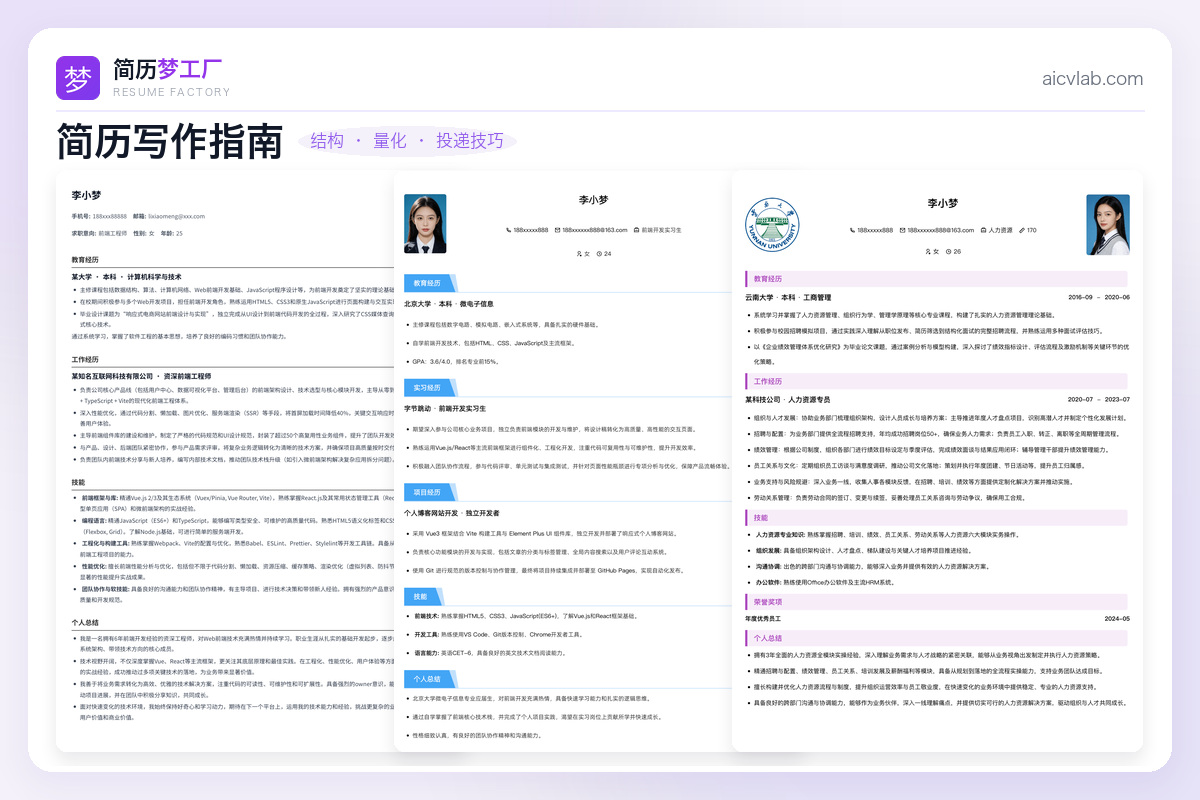
Job-Seeker Essentials

Resume Writing Guide

Covering campus recruiting, experienced hiring, and career transitions, with resume structures, expression methods, and optimization paths you can apply directly.

resume writing guidehow to write a resumeresume optimization tipsSTAR method

Standardized Structure

A clear information hierarchy lets HR locate your role match and key highlights within 10 seconds.

Result-Oriented Expression

Turn responsibility descriptions into business results to show your real output and scope of impact.

Scenario-Based Applications

Manage versions by campus/experienced/transition scenario, avoiding sending one resume to every role.

Industry Data Insights

2025 College Graduate Volume

12.22 million people

According to the Ministry of Education, the number of 2025 college graduates continues to rise, meaning fiercer competition for the same role, so resume quality directly affects your odds of reaching the interview stage.

Source: Ministry of Education Portal

Employability Policy

The "Dual-Thousand" Plan

A forwarded State Council document proposes offering 1,000 micro-majors and 1,000 vocational courses at universities, emphasizing that capability expression becomes a core evaluation point on the hiring side.

Source: gov.cn (MOHRSS/MOE/MOF)

Capabilities Employers Value (NACE)

Nearly 90% value problem-solving

NACE Job Outlook 2025 shows that nearly 90% of employers look for evidence of problem-solving on resumes, and about 80% care about teamwork.

Source: NACE Job Outlook 2025

Skill Change Trend (WEF)

Nearly 40% of core skills change by 2030

The WEF Future of Jobs 2025 notes that skill structures keep being reshaped; resumes should highlight transferable and continuous-learning abilities rather than piling up static experience.

Source: World Economic Forum

In-Depth Methods

Why Outcome Expression Beats Listing Responsibilities

Recruiters usually finish the initial screen in a short time, and listing responsibilities struggles to quickly convey your differentiated value. In contrast, outcome expression lets HR see your business impact directly.

We recommend an "action + object + metric change" format. For example, "rebuilt the ad landing page, lifting sign-up conversion by 18%" is more persuasive than "responsible for page optimization."

  • Prefer action verbs like led, designed, drove, optimized, and shipped.
  • Give at least one verifiable metric per experience where possible.
  • When metrics are lacking, add scope and impacted objects, e.g., "covering 20+ city channels."

Structural Principles of an ATS-Friendly Resume

An ATS (Applicant Tracking System) is not about keyword stuffing; it values structural parseability and role relevance more. Standardized heading levels, clear module naming, and standard date formats matter more.

We recommend keeping multiple versions for different roles: a master version that stays complete, and application versions that highlight high-weight keywords for the target role.

  • Suggested module order: target role -> key experience -> project results -> education and skills.
  • Write skills as "tech/tool + use case + output result."
  • Avoid overly complex layouts and keep the text searchable after exporting to PDF.

JD Comparison Checklist (self-check before applying)

Keyword coverage

Do the JD's high-frequency capability terms appear in your experience descriptions with corresponding project evidence?

Experience relevance

Do the top 3 experiences directly serve the target role, and have low-relevance items been moved down?

Quantified results

Does each core experience have at least one verifiable metric or clear business impact?

Layout readability

Can HR see the role direction, core capabilities, and representative projects within 10 seconds?

Case Studies (Before & After)

Operations Intern

Turning "assisted operations" into verifiable results

Before

Responsible for community operations and event execution, improving user activity.

After

Led tiered community operations and check-in campaigns, adding 2,100+ new users in 4 weeks and lifting 7-day retention by 24%.

Outcome: Upgrading from responsibility descriptions to result evidence significantly improves how quickly interviewers can judge.

Frontend (Campus)

Turning "participated in project development" into value expression

Before

Participated in back-office system development and wrote some of the pages.

After

Rebuilt the core reporting module of the back office and introduced lazy loading and caching, cutting first-screen load time from 3.2s to 1.9s.

Outcome: Making the technical actions and business results explicit demonstrates engineering ability and problem-solving.

Practical Tips

The core of a resume is not writing more but writing precisely. Organize your experience around the target role and prove your ability with result metrics to win in both machine screening and human review.

Recommended Approach

  • Use the STAR structure for experience: Situation, Task, Action, Result.
  • Attach quantified metrics such as conversion rate, cost, and efficiency to each experience where possible.
  • Sort skills by role priority, keeping content strongly relevant to the JD.

Common Pitfalls

  • Too much information without clear emphasis prevents HR from quickly judging value.
  • Inconsistent template layout hurts professionalism and readability.
  • Insufficient keyword coverage leads to a low match score after ATS parsing.

FAQ

How many pages should a resume be?

One page is recommended for most roles; deeper experience can extend to 2 pages, but key points must stay up front.

What if I have no internship experience?

Use course projects, competitions, and club operations instead, focusing on your role and results.

How often should I update my resume?

Tweak it against the target JD before each application and update result data after each stage.

Start Improving Your Next Resume Version

Pick a template first, then use AI to generate and optimize, and finally make targeted adjustments for the role to form a continuously iterable resume version.

Related Links

How-To Steps

  1. Define the target role: Extract the core capability terms and business scenarios from the JD as constraints for rewriting your resume.
  2. Reorder your experience: Bring the projects and results most relevant to the role to the front and lower the weight of irrelevant information.
  3. Quantify core results: Add at least one result metric to each key experience to boost credibility.
  4. Review ATS rules: Check heading levels, keyword hits, and export parseability to stay machine-screening friendly.
  5. Create application versions: Keep multiple versions by role type and do quick tweaks before applying.

Recommended Templates (sorted by usefulness)

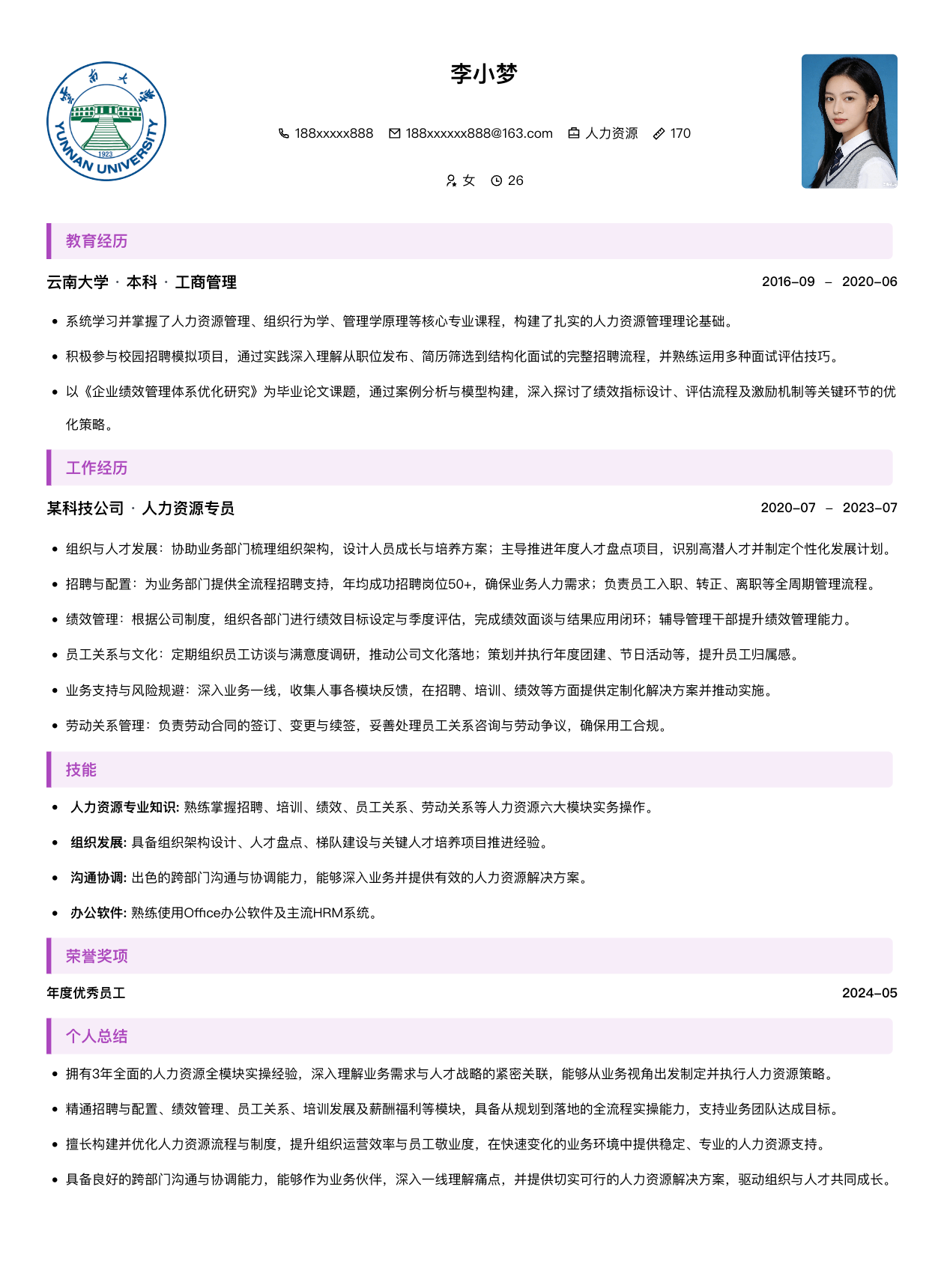
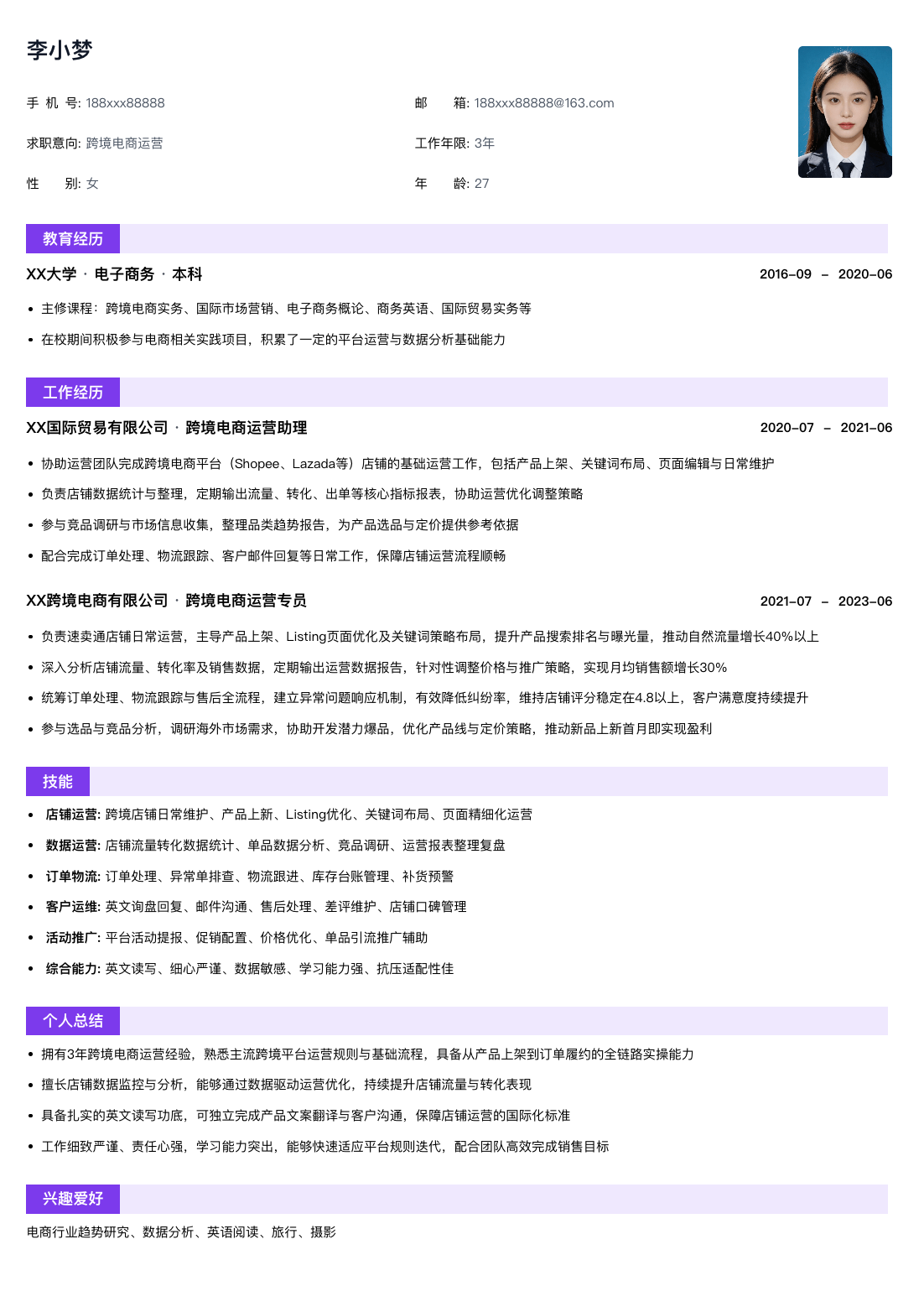
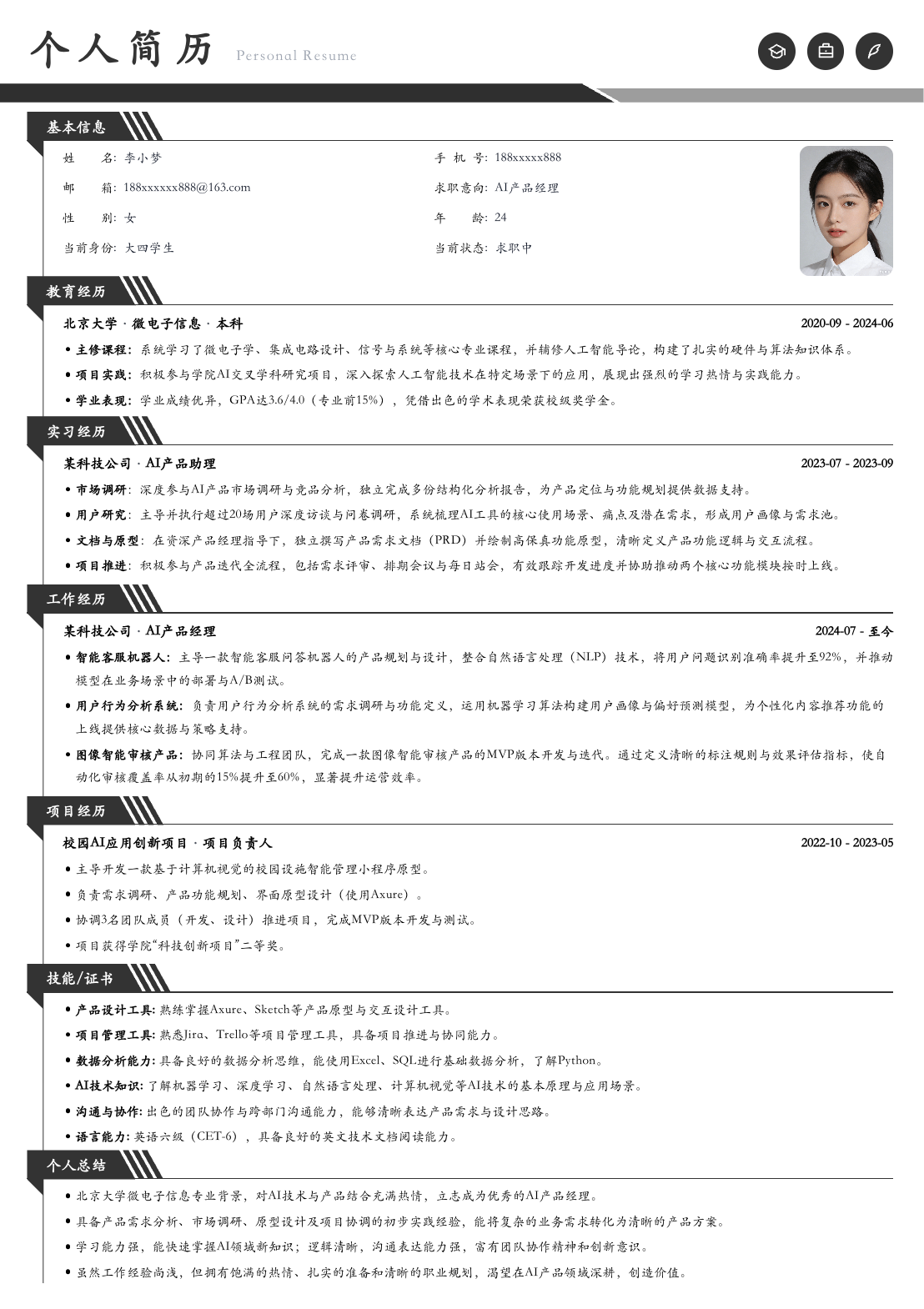
Resume templates recommended by popular usage trends, ready to preview and start editing.

View all templates

References