AI Feature

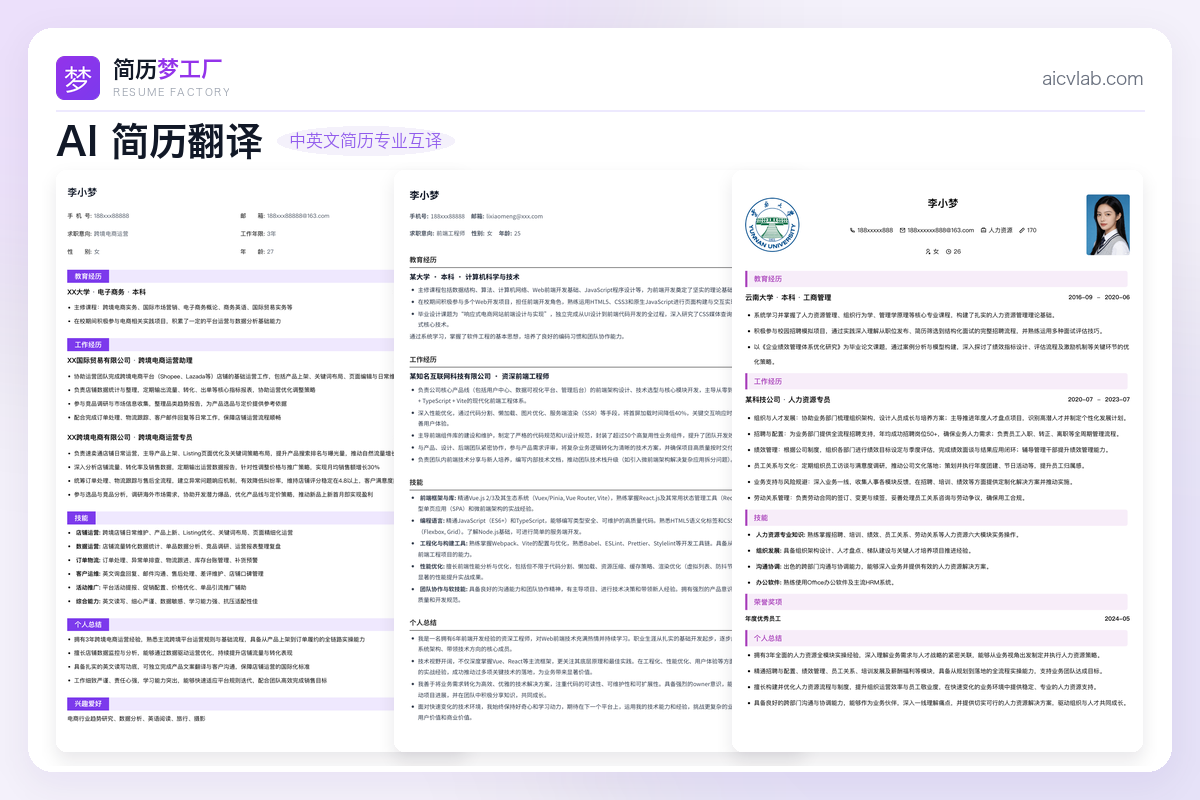
AI Resume Translation

Smart Chinese-English resume conversion that preserves professional terminology and outcome expression, tailored for foreign companies and global roles.

AI resume translationEnglish resume translationChinese-English resumeresume for foreign companies

Accurate Terminology

Preserve role keywords and professional terms to reduce the risk of semantic drift.

Professional Expression

Unify tense, grammar, and tone to match international resume conventions.

Application-Friendly

Account for ATS parsing to improve the recognizability of bilingual resumes in screening systems.

Industry Data Insights

Skills-Oriented Hiring Trend

Skill evidence is replacing background labels

LinkedIn notes that hiring decisions increasingly value skill evidence, meaning translation should prioritize preserving the capability-action-result structure rather than translating word for word.

Source: LinkedIn Global Talent Trends

Global Job Change

An estimated net 78 million new jobs by 2030

The WEF report shows the global job structure is being reshaped, making multilingual applications and cross-region job-seeking increasingly important.

Source: World Economic Forum

In-Depth Methods

Professional Rules for Chinese-English Conversion

An English resume is not a word-for-word translation of a Chinese one, especially regarding verb tense, quantity units, job titles, and project context, which all need localization.

We recommend first producing a fact-consistent base version, then doing a second pass for expression optimization, to avoid factual drift from over-polishing.

  • Preserve key terms: tech stack, methodologies, and industry vocabulary.
  • Unify tense: typically use the past tense for completed projects.
  • Rewrite implicit subjects in Chinese narration into explicit action subjects.

Chinese-English Conversion Self-Check

Factual consistency

Companies, projects, dates, roles, and result data must match across the Chinese and English versions.

Terminology standardization

Use common industry English for core tech, job titles, and methodologies, avoiding stiff literal translation.

Grammar and tense

Use the past tense for completed projects and the present tense for ongoing ones, keeping sentences concise.

Context adaptation

Localize wording for the target role and region to improve reading fluency.

Case Studies (Before & After)

Operations (Foreign Company)

Optimizing operations experience for English

Before

Responsible for community operations, improving activity and conversion.

After

Led community operations for 50k+ users, boosting weekly active rate by 22% and conversion by 15% through segmented campaigns.

Outcome: Upgraded from a responsibility statement to action plus results, better fitting a global recruiting context.

Product (Overseas)

Optimizing a product project narrative in English

Before

Participated in product design and was responsible for some features.

After

Owned the checkout redesign end-to-end, cutting drop-off by 12% and lifting revenue per user by 8%.

Outcome: Adding subjects and result metrics significantly improves readability and professionalism.

Practical Tips

Translating a resume is not about word-for-word mapping but about aligning with the recruiting context. The same experience needs to be converted into the expression more common in the target language.

Recommended Workflow

  • Complete the Chinese version first, then translate to English to ensure completeness.
  • After translating, focus on verifying role terms, project names, and metric units.
  • Do one more match optimization using the target JD at the end.

Common Pitfalls

  • Word-for-word translation sounds stiff and lacks recruiting context.
  • Ignoring result units and business background hurts comprehension.
  • An English version without localization still has a low match rate.

FAQ

Do the Chinese and English resumes need identical content?

Core facts should match, but you can adjust the order and emphasis of expression based on the role context.

Does the English version also need keyword optimization?

Yes, especially for terms and capability keywords common to the target role.

Do I still need manual proofreading after translation?

We recommend proofreading, especially professional terms, company names, project names, and numeric information.

Quickly Generate a Bilingual Resume

Generate a Chinese resume first, then run AI translation and diagnosis to form a more robust version for international applications.

Related Links

Templates suited for bilingual resumes

Templates for Chinese-English application scenarios, with more stable structure and clearer terminology display.

View all templates

References